
Open Badge Passport has updated its Terms of Use to strengthen protection for underage users and ensure compliance with global digital consent regulations.
As digital badges and micro-credentials expand across schools, universities, NGOs, and corporate training programs, organizations must protect younger learners. Therefore, Open Badge Passport now introduces clearer eligibility rules and automatic restricted access for minors.
This update reinforces responsible digital credentialing while maintaining access to recognition.
Why this update matters
Today, institutions increasingly use digital badges and Open Badges 3.0 credentials to recognize academic achievements, transversal skills, and professional competencies. Because many earners are students, platforms must adapt to varying legal frameworks.
Different countries define different ages of digital consent. Consequently, Open Badge Passport applies national regulations where they exist. If no verified national rule applies, the platform sets the minimum age at 16.
To ensure compliance, the system now includes:
Clear minimum age requirements aligned with national laws
Mandatory date-of-birth verification
Automatic restricted access for underage users
As a result, organizations can continue issuing digital credentials confidently while protecting minors.
What changes for underage users?
When the system identifies a user as below the applicable age of digital consent, it automatically activates Restricted Mode.
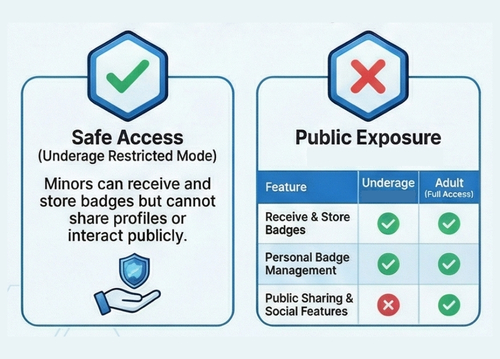
Under this model, underage users can:
✅ Receive digital badges
✅ Store Open Badges securely
✅ Manage their badge collection for personal use
However, the platform disables interactive and public features. For example, underage users cannot:
❌ Share or publish badges publicly
❌ Access social or community features
❌ Comment, follow, or interact within Spaces
❌ Make their profile visible
This “simple backpack” approach allows learners to collect digital credentials safely. At the same time, it prevents exposure to public or social environments.
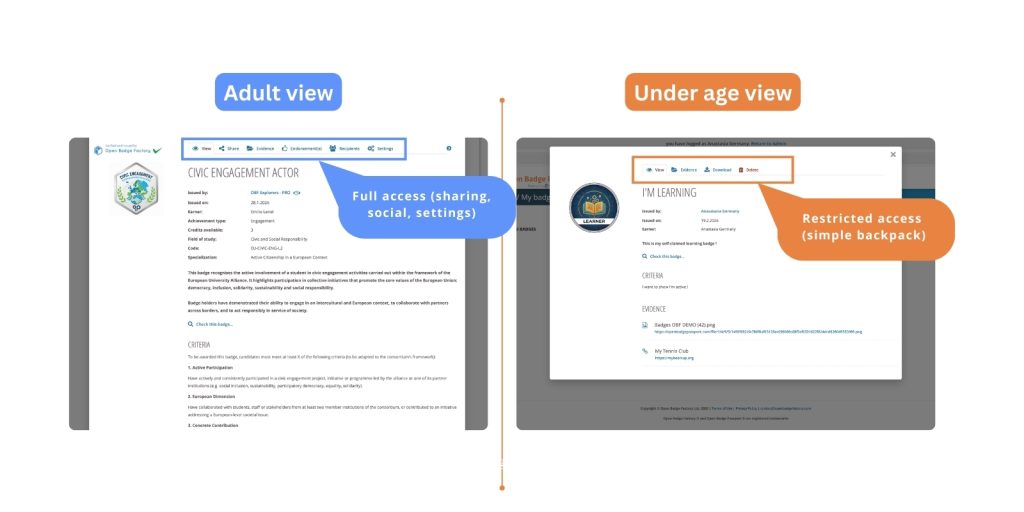
Importantly, the system enforces these restrictions automatically. Users cannot modify or bypass them.
Respecting global legislation
Because digital consent laws vary across jurisdictions, Open Badge Passport applies a structured verification process.
At account creation — or at first login after implementation — users must confirm their date of birth. The platform uses this information exclusively to determine eligibility and access level. It does not store the date-of-birth data.
In addition, underage users must re-verify their age every six months. Once a user reaches the legal age of digital consent, the system automatically restores full access.
Through this approach, Open Badge Passport aligns with GDPR principles and international data protection frameworks. Consequently, organizations reduce compliance risks when issuing digital badges to minors.
What this means for organizations
Schools, universities, alliances, NGOs, and corporate training providers frequently issue digital badges to learners under 18. Therefore, they must ensure legal clarity and platform-level safeguards.
With this Terms update, organizations benefit from:
Automated age-based access management
Reduced legal uncertainty across countries
Safe deployment in K-12 and youth programs
Stronger data protection standards
Responsible Open Recognition practices
Instead of managing age compliance manually, institutions can rely on built-in safeguards within the badge wallet.
Secure recognition in our Badge Wallet
Open Badge Passport functions as a secure digital badge wallet where earners can:
Collect Open Badges 2.0 and 3.0 credentials
Build micro-portfolios
Add evidence to strengthen recognition
Participate in dedicated organizational Spaces
For underage users, the simplified backpack model ensures continuity of learning recognition without enabling public exposure. Meanwhile, adult users retain access to the platform’s full interactive capabilities.
As digital credentials increasingly replace paper certificates, governance and compliance become strategic priorities. Therefore, strengthening age protection mechanisms directly supports long-term trust in digital credential ecosystems.
A commitment to responsible digital credentialing
Open Badge Factory believes that recognition must remain: portable, verifiable, secure, inclusive, legally compliant.
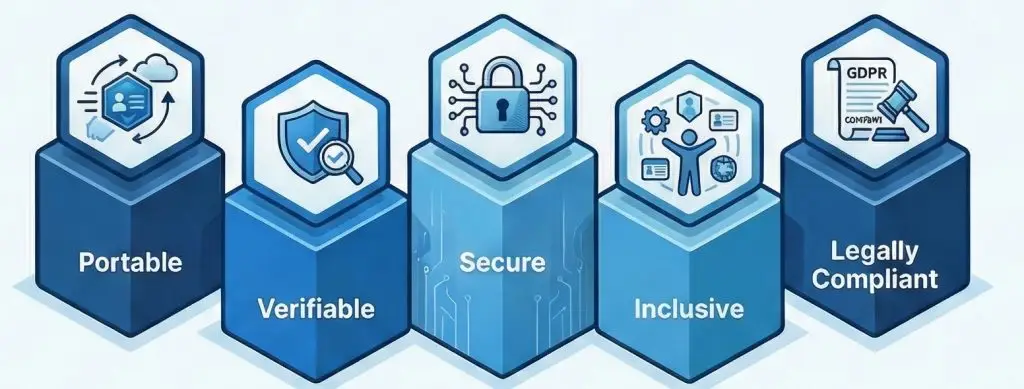
This update to the Open Badge Passport Terms of Use demonstrates a proactive commitment to responsible digital credentialing worldwide.
If your organization issues digital badges to minors and would like guidance, our team is ready to help.