Badge of achievement INDIGO Innovation Challenges for Local Government
Badge awarded to
Sufyan Abu Aldabaat
Issued on 25 May 2026 by
GFA
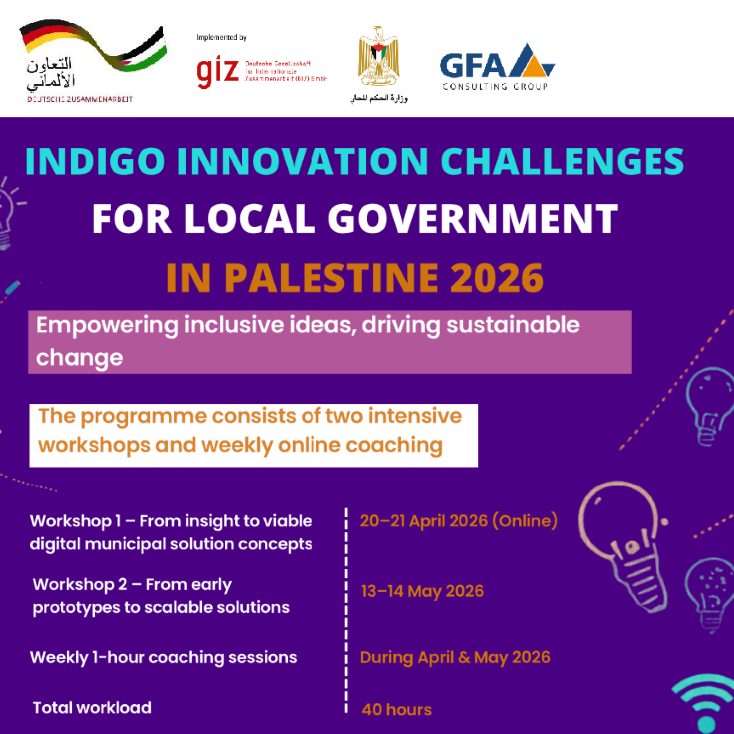
The INDIGO Innovation Challenges for Local Government Hackathon is part of project “Developing Capacities for Human-Centred and Inclusive Service Design in Palestinian Municipalities”, which falls under INclusive DIgital GOvernance (INDIGO) II implemented by the Deutsche Gesellschaft für Internationale Zusammenarbeit (GIZ) on behalf of the German Federal Ministry for Economic Cooperation and Development (BMZ).
During the hackathon, participants applied the Human-Centred Design (HCD) methodology in a structured, hands-on format to work on one of six thematic tracks. Through guided, sprint-based HCD materials, teams mapped real municipal challenges, identified innovation opportunity areas, and designed and prototyped solutions that respond directly to the needs and lived experiences of citizens in Palestine.
Issuer
GFA
paula.morais@gfa-group.de
Criteria
The participants successfully attended and significantly contributed to one of the following topics/themes around GovTech, using Human-Centred Design:
- Emergency Response – resilient, citizen-focused crisis and preparedness solutions
- Mobility – accessible and efficient urban and transport services
- Sustainable waste management and sanitation– circular and inclusive approaches to effective waste collection, treatment, and disposal
- Water access and resilience– reliable access and strengthened resilience to climate and resource pressures
- Public Digital Financial Services – inclusive and transparent financial service delivery
- Data Governance and Interoperability – enabling data-driven, connected municipal services
The following learning objectives were achieved:
- Identify the principles of Human-Centred Design and its application to digital public services.
- Apply Human Centred Design frameworks and tools in the sprint.
- Learn universal digital design principles to ensure prototypes and service solutions are inclusive and accessible, “accessible by default”.
- Integrate sustainability strategies into local municipal (e)-infrastructure and e-services.
- Understood the existing digital governance ecosystem in Palestine and its systemic challenges across stakeholders.
- Pitch the prototypes and developed Minimum Viable Products (elevator pitch style).